Connecting to Oracle BI Publisher (extractor)
Important
Any references to third-party products or services do not constitute Celonis Product Documentation nor do they create any contractual obligations. This material is for informational purposes only and is subject to change without notice.
Celonis does not warrant the availability, accuracy, reliability, completeness, or usefulness of any information regarding the subject of third-party services or systems.
The Celonis Oracle BI Publisher extractor transfers operational data from your Oracle BI Publisher instances directly into the Celonis Platform for process analysis. Extracting financial and transactional records, such as purchasing cycles or billing logs, surfaces execution bottlenecks and identifies process inefficiencies.
Note
Reports are extracted via the Oracle BI publisher SOAP API (Simple Object Access Protocol API). For more information, see: SOAP methods used by the extractor.
This section details important prerequisites or prerequisite knowledge for using this extractor.
Method | Description | API / Technical details | Further information |
|---|---|---|---|
Basic authentication | Provide a username and password | Uses the standard HTTP Authorization header. Credentials are transmitted as a Base64-encoded string in the format "username:password" prefixed by "Basic ". | Refer to your specific application endpoint's API reference for standard user credential policies. |
JWT Authentication | Authenticates integrations using a JSON Web Token (JWT) Bearer token and an RSA key pair, specifically utilized for secure connections to BI Publisher and Oracle Fusion. | • Connection: OAuth 2.0 configured with "JWT Bearer + Private Key" grant type • Host and Audience: The base Oracle Fusion URL • Private Key: Full content of the private_key.pem file (including BEGIN and END lines) • Issuer: Case-sensitive Trusted Issuer name registered in Oracle Fusion • Key ID: Exact alias of the public certificate uploaded to Oracle Fusion • Subject: Oracle Fusion username executing the report extractions | For step-by-step instructions on generating RSA key pairs, uploading public certificates, and registering trusted issuers, see: Oracle Token-Based Authentication Tutorial (follow from step 2 onwards). |
You need access to an Oracle BI Publisher user with the following permissions enabled:
Create and edit Data Model
Access to the tables that should be extracted
Create and Download Report
Access to SOAP service
If your Oracle BI Publisher instance is protected by a firewall, you must allowlist the outbound IP addresses of the Celonis Platform to enable data extraction. Outbound IPs vary based on your cloud cluster (such as eu-1 or us-1).
For more information, see: Allowlisting Celonis domain names, IP addresses, and third-party domains
The extractor utilizes the Oracle BI Publisher SOAP API to pull your configured reports. The following SOAP methods are used by this extractor:
getReportDefinitionReturn - Used to retrieve report's name and for connectivity check.
getXDOSchemaReturn - Used to retrieve report's metadata.
runReportReturn - Used to extract report's data.
When configuring your reports in Oracle BI Publisher, the following applies:
Format: To extract a report it has to be saved in XML format. This can be done in Oracle via Edit Report > View a list > Output Format: Data (XML) > Default Format: Data (XML) > Save.
Maximum size:
524288000 bytes. To support this, you can create parameters for your reports and then filter the data based on that parameter. Create a date parameter to limit the extraction payload to a defined window and prevent system timeouts.
For further information about using Oracle BI Publisher, see: Oracle.com - Oracle BI Publisher Overview and Best Practices and Docs.Oracle.com
This section describes the basic setup of configuring the Oracle BI Publisher extractor. To configure the extractor:
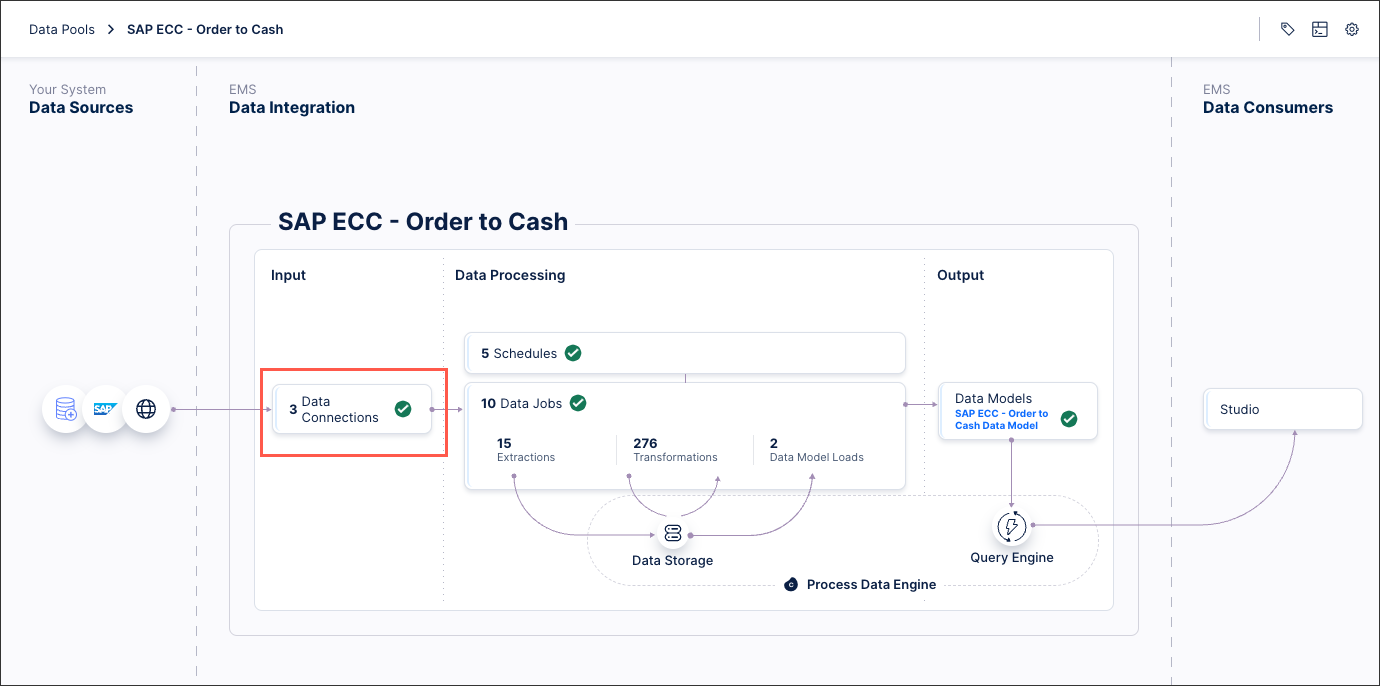
From your data pool diagram, select Data Connections.
Select Add Data Connection and select Connect to Data Source.
Select Cloud - Oracle BI Publisher.
Configure the following connection details:
Host: The URL of the Oracle BI publisher that you want to connect to. Use the following format here:
https://ExampleInstanceID.oracle.com
Username and password: The username and password for the user configured in the prerequisites. Celonis uses key-based authentication by including the username and password in each request payload.
Note
Ensure the user credentials provided have adequate permissions to extract the desired data. For more information, see Oracle BI Publisher user permissions.
Report configurations: Enter the file path for each Oracle report you intend to ingest into your data pool. Format each entry as a distinct line item utilizing the relative path.
For example, to extract purchase order history for an Accounts Payable analysis, enter:
/~ap_analytics/AccountsPayable_Invoices.xdoNote
Reports must be in XML format to be extracted. For more information, see Report configuration and further information.
Select Test Connection, and correct any issues highlighted.
Select Save.
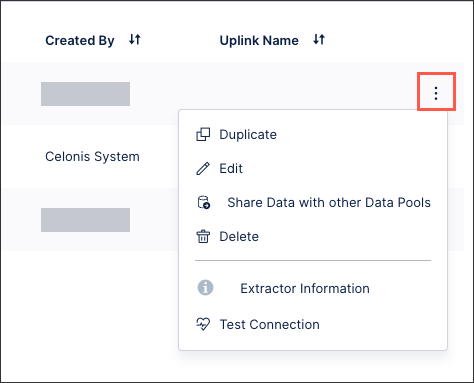
The connection between your Oracle BI Publisher tenant and the Celonis Platform is established. Manage this connection at any time through the actions menu.
Filters are only supported for SQL-query based reports which are configured in BI Publisher. When used in the Celonis Platform, filters always need to be passed as a string value.
To set up filters for your Oracle BI Publisher instance:
Create a database view within the Celonis Platform to calculate the maximum value of your tracking column and convert it to a string format. This view matches your source parameters to enable delta extractions. For example, to isolate and extract only the newest invoices created since your last replication run in an Order-to-Cash workflow, execute the following query:
CREATE VIEW otc_parameter_view AS (
  SELECT TO_CHAR(MAX(CREATION_DATE), 'MM-DD-YYYY') AS parameter_column FROM order_headers_G_1
);
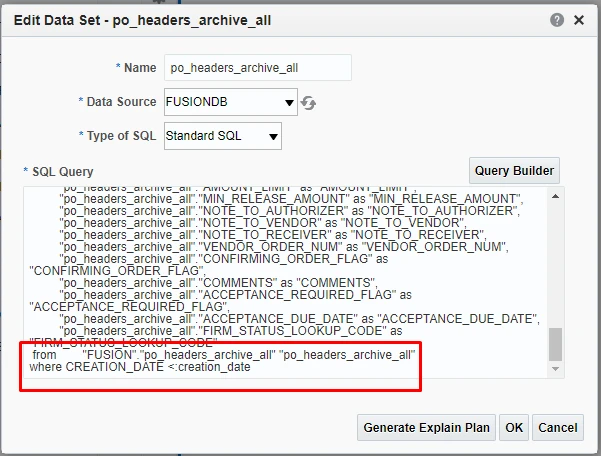
Include the parameter in the SQL query that you define in the BI Publisher report.
For example:
When configuring an extraction in the Celonis Platform, you can now define a value for the parameter by using the filter statement.
You can only assign values to this parameter, meaning you need to use the = operator.
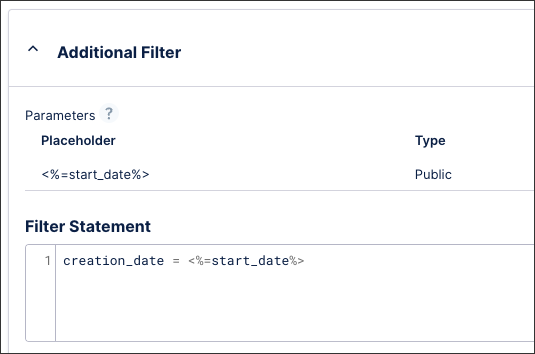
You can configure delta filters in the same way by using dynamic extraction parameters. See: Using delta filters with dynamic parameters.